

I Don’t Feel Like Myself Anymore: Emotional Numbness Explained Clearly
- Katrina Case, MSN-Ed., RN
- Mar 24
- 4 min read

Why I Don’t Feel Like Myself Anymore
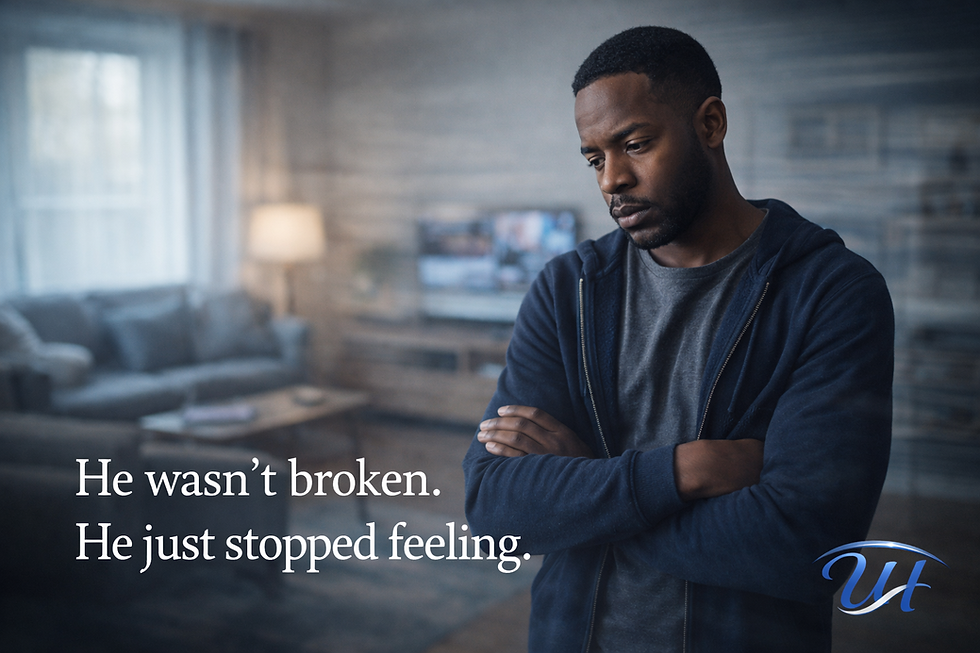
Emotional numbness is often misunderstood as indifference or emotional detachment by choice. In reality, it is a protective psychological and neurobiological response that occurs when the brain is overwhelmed by prolonged stress, trauma, or emotional strain.
When someone says, “I don’t feel like myself anymore,” they are often describing a state where:
Emotions feel muted or absent
Joy, sadness, and connection are difficult to access
Internal experiences feel distant or unreal
This state is commonly associated with dissociation, emotional suppression, and trauma-related adaptation (American Psychiatric Association [APA], 2022; McLaughlin & Lambert, 2021).
“Numbness is not the absence of emotion—it is the mind’s way of surviving what it cannot safely process.”
The Science Behind Emotional Numbness
Emotional numbness is deeply rooted in how the brain and body respond to sustained stress.
When exposure to stress or threat becomes prolonged, the nervous system may shift beyond fight-or-flight into a freeze or shutdown state, reducing both emotional and physical responsiveness (Kozlowska et al., 2021; Porges, 2021).
This can result in:
Emotional flatness
Reduced reactivity
Feelings of detachment from self or surroundings
Brain Function and Emotional Regulation
Chronic stress affects the interaction between the amygdala (emotion processing) and the prefrontal cortex (regulation and decision-making). Over time, this can lead to reduced emotional awareness and increased suppression (McLaughlin & Lambert, 2021).
Dopamine and Emotional Blunting
Emotional numbness is also linked to disruptions in dopamine pathways, which are responsible for motivation, reward, and pleasure. When these systems are dysregulated, individuals may experience anhedonia, or the inability to feel enjoyment (Der-Avakian et al., 2021).
Psychological Perspective
From a psychological standpoint, emotional numbness often reflects:
Dissociation – a separation between emotional experience and awareness (APA, 2022)
Emotional suppression – reducing emotional expression to avoid distress (Gross, 2022)
Trauma adaptation – the mind’s effort to maintain functioning under prolonged stress (McLaughlin & Lambert, 2021)
In environments where emotional expression is unsafe—such as controlling or abusive relationships—the brain may learn:
Feeling = vulnerability
Vulnerability = risk
Over time, the mind adapts:
No feeling = safety
“When emotions become unsafe, the mind chooses silence over suffering.”
Sociological and Relationship Context
Emotional numbness does not develop in isolation. It is often shaped by social environments, relationships, and lived experiences.
In controlling or abusive relationships, individuals may experience:
Loss of autonomy
Emotional invalidation
Psychological manipulation
Chronic stress and fear
These conditions align with what sociology and psychology describe as coercive control, which can significantly alter identity, emotional regulation, and perception of self (Stark, 2021).
Over time, individuals may begin to:
Disconnect from their own emotions
Suppress internal responses
Lose a sense of identity
This is not a failure—it is a survival response shaped by environment.
A Real Experience
After three years in an abusive relationship—marked by manipulation, control, surveillance, verbal harm, and moments of physical abuse—something shifted.
At first, there were emotions:
confusion
hurt
fear
Then gradually:
less reaction
less expression
Just… numb.
This is not uncommon. In fact, it reflects a well-documented trauma response where the mind reduces emotional intensity to endure ongoing distress (McLaughlin & Lambert, 2021).
Ways to Cope and Reconnect
Healing from emotional numbness is not about forcing feelings—it is about re-establishing safety and gradually reconnecting with emotional experience.
1. Nervous System Regulation
Practices such as:
Deep breathing
Grounding techniques
Gentle physical movement
These help regulate the autonomic nervous system and reduce the freeze response (Porges, 2021).
2. Gradual Emotional Awareness
Rather than forcing strong emotions, begin with:
Noticing physical sensations
Identifying subtle emotional shifts
Allowing feelings without judgment
This supports emotional reintegration (Gross, 2022).
3. Therapeutic Support
Evidence-based approaches include:
Trauma-focused cognitive behavioral therapy (TF-CBT)
EMDR (Eye Movement Desensitization and Reprocessing)
Somatic therapies
These approaches help process trauma and restore emotional connection (APA, 2022).
4. Safe Environments and Relationships
Healing requires environments where:
Emotional expression is safe
Boundaries are respected
Validation is present
Supportive relationships are strongly associated with improved emotional recovery (Stark, 2021).
5. Reconnection Through Expression
Writing, art, and reflection can help reconnect internal experience with external expression, improving emotional awareness over time (Gross, 2022).
“Healing does not begin when everything feels again—it begins when safety returns.”
Conclusion
It is the mind’s way of saying: “This was too much.” And so it protects. It quiets. It pauses. But numbness is not permanent. With time, safety, and intentional healing, emotions begin to return—slowly, gently, and often in unexpected ways. Not all at once. Not all the same. But enough.
Enough to remind you: You are still here. You are still capable of feeling. You are still capable of healing. Even if you don’t feel like yourself anymore— you are not lost. You are waiting to feel again.
References
American Psychiatric Association. (2022). Diagnostic and statistical manual of mental disorders (5th ed., text rev.).
Der-Avakian, A., Barnes, S. A., & Markou, A. (2021). Chronic stress and anhedonia: Neurobiological mechanisms. Neuropsychopharmacology, 46(1), 1–15.
Gross, J. J. (2022). Emotion regulation: Current status and future prospects. Psychological Inquiry, 33(1), 1–26.
Kozlowska, K., Walker, P., McLean, L., & Carrive, P. (2021). Fear and the defense cascade. Harvard Review of Psychiatry, 29(3), 158–172.
McLaughlin, K. A., & Lambert, H. K. (2021). Childhood trauma and emotional regulation. Annual Review of Clinical Psychology, 17, 111–135.
Porges, S. W. (2021). Polyvagal theory and safety. Frontiers in Integrative Neuroscience, 15, 1–10.
Stark, E. (2021). Coercive control and its psychological impact. Violence Against Women, 27(1), 1–17.


Comments